
Women’s Place in History
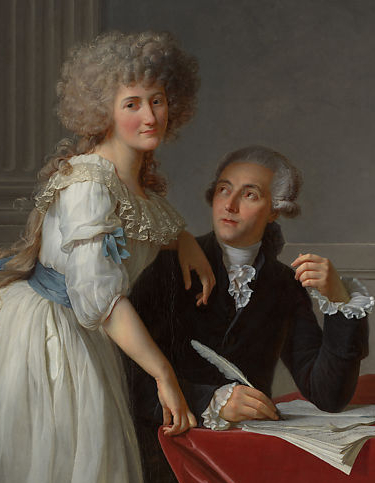
When I look at the portrait of the Lavoisier’s by David, I find that the real center of the piece is Marie Anne Lavoisier. Looking at it with fresh eyes I cannot believe that I had not seen it before. Everything about it says I— Marie Anne— am what this piece is about. Her face is centered on the canvas, not the two of them, just her, he is located off center. Even when you don’t look at her placement on the canvas, the artist is directing you to look at her in two ways. For one, she is the only subject looking out to the audience. Secondly, even if your initial inclination is to look at Antoine, he is directing you to look at her too. The prominent famed chemist is not looking out of the canvas saying look at me. He is not even engrossed in some action that would show him at his work, emphasizing his import as a subject. No, he is looking at her, and she looks at us. Inviting us to look at her. Because she is the focus, and Antoine knows it too. So, who was Marie Anne Lavoisier?
I have already referred to her in this series as an artist and scientist, and she was. Here’s the crux of the matter. Until I went down this quest, I had no idea who she was aside from her name and her relation to Antoine Lavoisier. As someone who pursued science for their post-secondary education, I heard plenty of Antoine Lavoisier. All introductory science courses in my post-secondary education dedicated a portion of the course to the people, mostly men, that innovated fields of science. We are told repeatedly about Aristotle, Archimedes, Pythagoras, Galileo, Avogadro, Boyle, Linnaeus, Kepler, Newton, and of course Lavoisier — just to name a few. Lavoisier is unquestionably considered the father of chemistry. But would we know him, or would he have accomplished as much if it were not for her and their collaboration?
Marie Anne was also a chemist. She received her early education at a convent. Later, she studied art with David. During her marriage to Lavoisier, she became interested in the field of chemistry and was trained by fellow chemist Jean Batiste Bucquet. She was also a polyglot. She translated scientific writings from Latin and English so that Antoine could read them in French. She was his partner not only in marriage but work. She was the principal data collector, editor, and illustrator on their published works. She used her formal art training to make detail drawings of experiments and equipment so that their experiments could be re-created. As a scientist you want your experiments to be re-created so that their results can be reproduced, this is what gives credence and validity to your work. Who knows if we would remember Lavoisier’s name or contributions if it were not for her? So, if he was the father then it must follow that she was the mother of chemistry.
Being a collaborator in Lavoisier’s works was not all she did for us to know and remember their work. During the French Revolution the Lavoisier’s were among a group of people that fell into disfavor with Robespierre and the Jacobin followers. They were arrested and all their assets seized. They were both imprisoned and Antoine lamentably was executed while she was eventually set free. After Antoine’s execution she became his champion. She used her voice and the credibility she had established in the years before to publish what I think would be today’s equivalent to an open letter. In it she denounced the accusations towards Antoine and the unjust trial and execution that followed. She fought to regain custody of their scientific equipment that they produced themselves along with all their papers and notes. She eventually won her case against the French government. She continued to publish on experiments they had conducted and comment on other scholarly work. Other notable chemist of the time, be they French, English, or American would consult with her. This evidence can be found in contemporaneous notes of scientists. It is through these contemporaneous writings that show us she was regarded on her own merit. Not just as Antoine’s secretary as some later accounts would refer to her, but another scientist. I wonder if Antoine Lavoisier had figured out his theory on the distinguishing features between elements and compounds; if he would be credited with discovering oxygen, sulfur, and carbon at the time that he did were it not for her collaboration. Would these breakthroughs have happened later by someone else? Would his works have gone into obscurity following his death, forgotten, and credited to someone else had it not been for her? So when did she become invisible to us? Because she wasn’t then.
We, as a society continue to downplay women’s roles and their achievements posthumously. If you ask most people to name a famous female scientist, most will probably name Marie Curie. But she was not an anomaly. She was not some exception to the rule, and neither was Marie Anne. Women have not been behind the curve of innovation. But we have been continuously written out of taught history. Case in point Marie Anne Lavoisier. How David depicts her is not as invisible. On the contrary he portrays her as someone to take notice of. The narrative I see David make is that she is the personification of the Enlightenment — the future. David was a proponent of educating women. He himself educated female artists and was an advocate for inclusivity of female artist at the Academy. Marie Anne as a trained artist and chemist was the union of art and science. She represented the educated, cultured mind that embodied the progressive society that by Enlightenment tried to bring forth. Initially I thought that using a woman as the characterization of the Enlightenment movement was revolutionary by David. But I’m looking at it through the perspective of today and the learned biases of our culture. That bias that women are only recently coming into the forefront. That only in modern times have women been given opportunities to thrive outside of their gender roles. But would it have been as shocking during David’s time?
The truth is that in David’s time there were plenty of female scholars, writers, artists, philosophers, mathematicians, and scientist. Yes, they were almost exclusively of upper or noble class but so were the men. The ability to be educated was more indicative of class not gender. Yet, we know little if anything at all about these women. This only shows me that the struggle for women to be recognized is not a struggle that began with the suffrage movement in the 19th century nor the feminist movement of the 20th century. It is a continual struggle. One in which there are two camps among the male establishment, one that sees women’s accomplishments and the other that refuses to accept them. They say that history is written by the winners. So, what does that say about our society that when history texts are written, even now, women are left out. We don’t teach our next generation of all the accomplishments of the past generations, only a selective narrative.
I would like to say that our times are different, and the increasing trend of inclusivity will revise how we see history and record it. But women also held places in past societies and have been forgotten. Only time will tell if the accomplishments of today’s women will be remembered or thrown into obscurity as before.

 Sense of Wonder