There is a gut feeling I get while pondering that sets me off in a wandering quest— a meander. It might take me to discover new territory, but sometimes it might bring me to a territory already visited. I think it is important to allow ourselves to wander in those spaces — new and old. This is how we fully open ourselves to new experiences, insights, and transformation. We don’t always end where we intend to go, and what we discover along the way is the reward. My recent meander will bring us through a multi-part series.
I did not anticipate when I opened my phone’s newsfeed one morning that it would lead me through such a journey. And it all started with an article about the portrait of French chemists Antoine and Marie-Anne Lavoisier by the French painter Jacques-Louis David. It is a portrait I have seen before at the Met. Here’s the thing, even though I had seen the portrait before, I had never paid much mind to it. Though an art lover, I must confess, portraits of random people sitting in chairs, even revolutionary people, didn’t interest me much outside of a reference of how clothing has changed. The thought, “another rich person, wow, tell me why I should care…” often crossed my mind. I have come to rethink the significance of portraiture because of this one portrait and the unexpected journey that ensued.
Part 1: Where Science and Art Meet
First let’s start with the article. It discussed how curators and restoration teams are using science to see the underlying layers of artworks. These concealed layers can sometimes tell their own story, beyond what is visible to us hanging on the wall. Enter infrared reflectography and x-ray fluorescence spectroscopy. We are about to get very technical for a bit but stay with me. For those wondering, spectroscopy is used to identify certain compounds or elements by analyzing the interaction of a sample, in this case paint, with a form of radiation. There are different methods and types of spectroscopies and which one you use is determined by what you need to identify and your sample. I have used these methods myself to identify minerals and elements for scientific research. I was fascinated by this application to the field of art. You may wonder, how is this being used? You can use spectroscopy to identify the minerals used in paints. Many artists mix their own paints, using their own pigments and minerals to not only achieve a color but for a visual effect such as iridescence. For example, the color red we see is a vermilion pigment. The pigment is made from the mineral cinnabar which is composed of mercury and sulfur. So, under spectroscopy if you are trying to identify mercury all the areas made with vermilion pigment will be highlighted on the scans. Where it gets interesting is when areas are highlighted that shouldn’t contain red. This is where you start to see the hidden layers.
It is known that artist often reuse canvases. Sometimes they paint over discarded pieces; sometimes it is editing the initial composition. In this portrait what was revealed has changed how curators place the portrait in historical context, and the artist’s process of creating this portrait. What was discovered through spectroscopy was that there was red under the blue ribbons of Marie-Anne, and that her outfit was different than what we see. She was more elaborately dressed with hat and all, showing off more of her wealth instead of the laid-back work attire on the surface layer. The very prominent red tablecloth was added later as a revision since there is highly detailed work on the underlying table and beneath the table. Other findings included a completely different background and changes in pose.
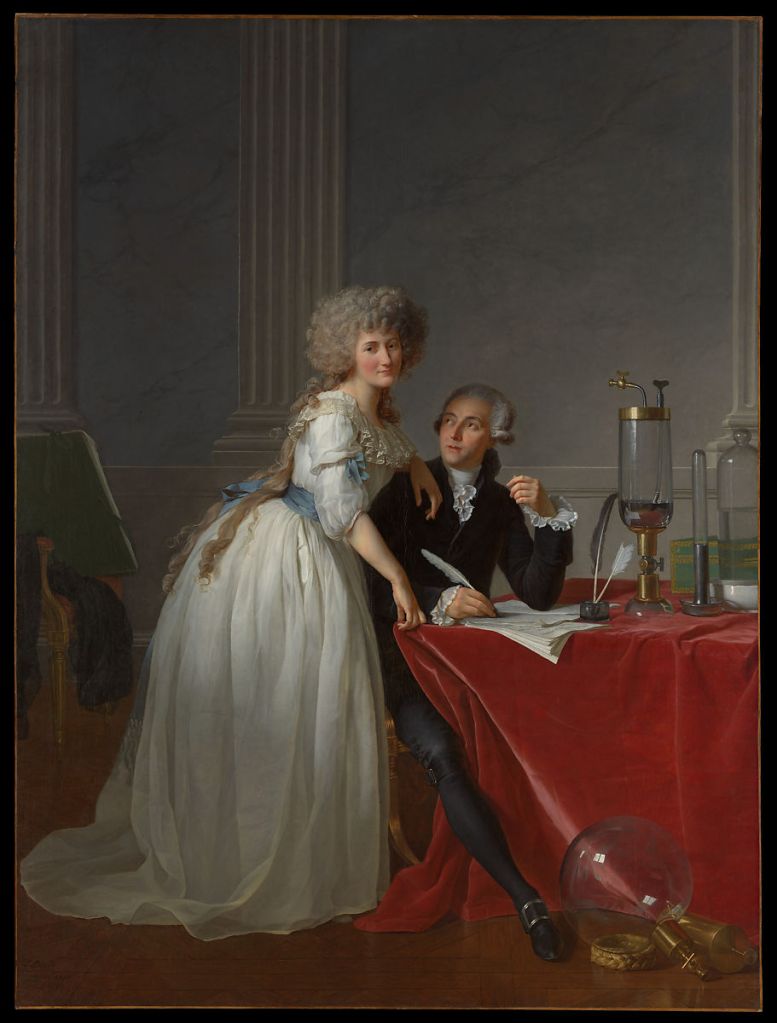
Why does this change how curators see this painting? To answer that we must look at the historical context. The Lavoisier’s were a couple that epitomized the ideals of the French Enlightenment in Parisian life. He, a well-respected chemist and she, an educated woman who was not only his partner in research but also and artist — a former student of David himself. The Lavoisier’s represented the dichotomy between the elite class of French society that benefited from the monarchy and the progressive thinking circles that led to the French Revolution. The original composition showed their elite standing in society while the portrait that we see today tones them down to be relatable. Their wealth status was diminished and their roles heighted. The scientific instruments for their research in chemistry and the portfolio in the background representing her as an artist. These contrasting images are important because the portrait was initially made on the eve of the French Revolution. It was supposed to be debuted at the 1788 Salon (in the Louvre) as a duet set with David’s painting of Paris and Helen of the Iliad.
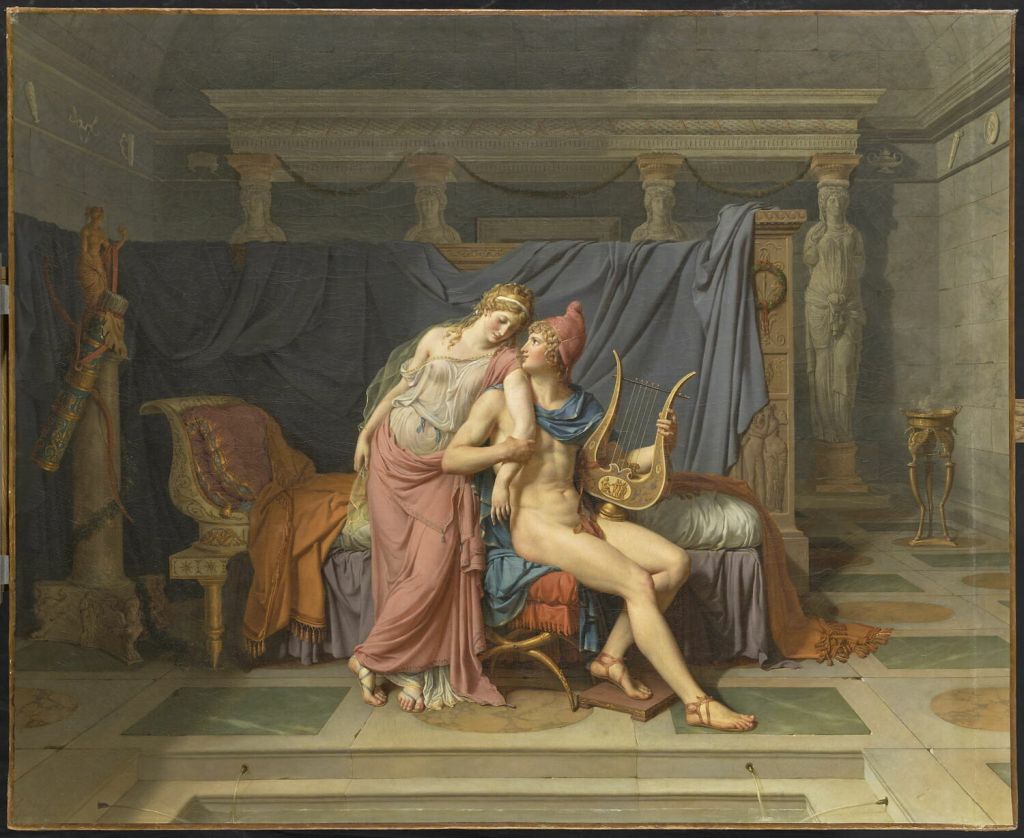
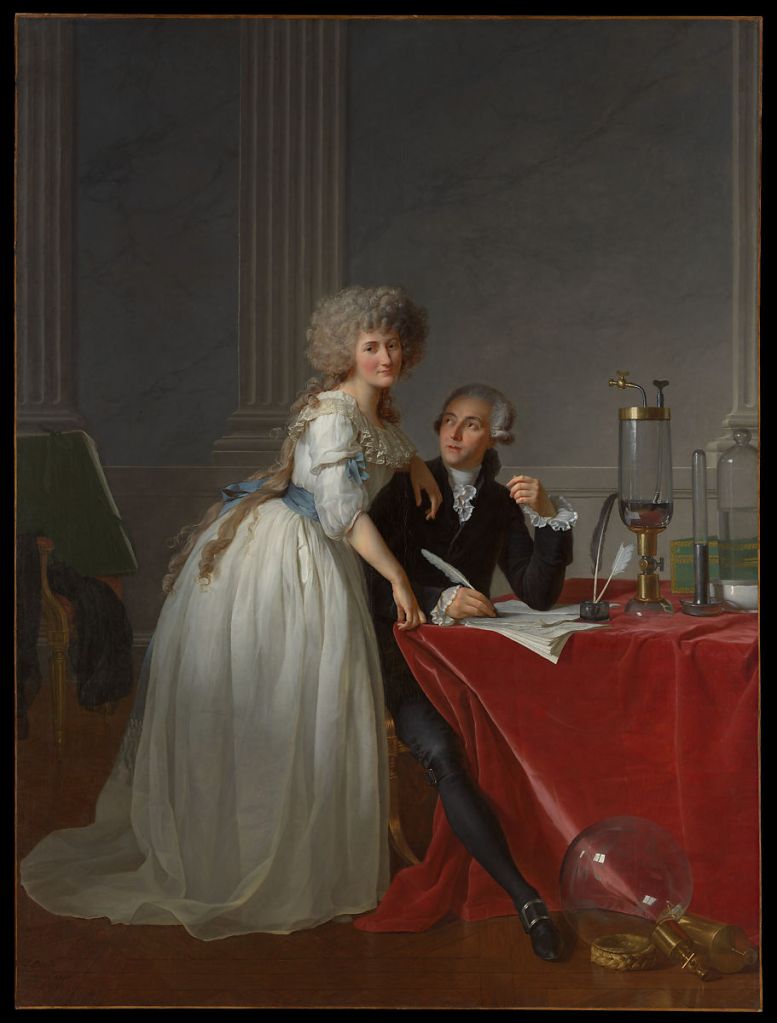
The Lavoisier’s portrait was scrapped at the end for fear of public backlash and only the scene of Paris and Helen debuted. Some time in between original composition it was revised. The portrait had been seen quietly after revisions but was not displayed publicly until a century later. These changes in composition show how an artist can use their medium to sell an idea. The idea of the “modern couple” of the Enlightenment. A couple that works together, are both educated and perform a role in society besides the traditional gender roles. The idea of being useful (utilité) in society was a benchmark in Enlightenment ideals. With the stroke of his brush David masterfully covered a portrait within another. He changed the impression of two people from the unfavorable idea of the elite noble couple to the modern ideal of not only the couple, but the inspiration to society. An ideal of partnership and collaboration.
Unfortunately, at the time the portrait was made there was too much bad press around Lavoisier. Though a proponent of the French Revolution his role as a tax collector led to his untimely demise via guillotine in 1794. How we see these two people changed from the contemporaneously unfavorable view to a more sympathetic perspective thanks in part to this portrait. Now, thanks to the discovery of the underlying portrait we must change our perception again. This time to a more nuanced perspective not just the narrative the artist sold.
I must also point out that it was not lost on me that we only discovered this hidden portrait through spectroscopy. A technology only possible through the principles that descended from the Lavoisier’s discoveries. The Lavoisier’s revolutionized chemistry and our understanding of elements and compounds, which is why they are called the father and mother of chemistry. These masters of their fields, the Lavoisier’s in science and David in art had me thinking on the intersection between science and art. When I think about it… art and science don’t merely cross paths but have often walked the same path. The path of innovation. And that is what will follow in part 2 of this series.

 Sense of Wonder